Tuesday, April 30, 2013

Prototype Video is here!

Here is a live demonstration of our Simon prototype! How exciting!

This week we are going to finish the other 4 buttons, make a few adjustments based on our peers' experience with the game and make another user study.

A few things we noticed that has to be "rethinked"-

  • The wiring is still quite loose and fragile, this will be fixed when we finish building a case for the display.
  • The buttons move during the game- we need to think of a way to make them more stable and safe (for players and the mechanics/electronics)
  • The "correct" notification+sound is sometimes confusing to the users, makes them think they need to follow a really quick and hard sequence and not just the gradual sequences in between the "correct" notification
  • We might change the angle of the buttons- might be more affordable and inviting

Monday, April 29, 2013

Almost There

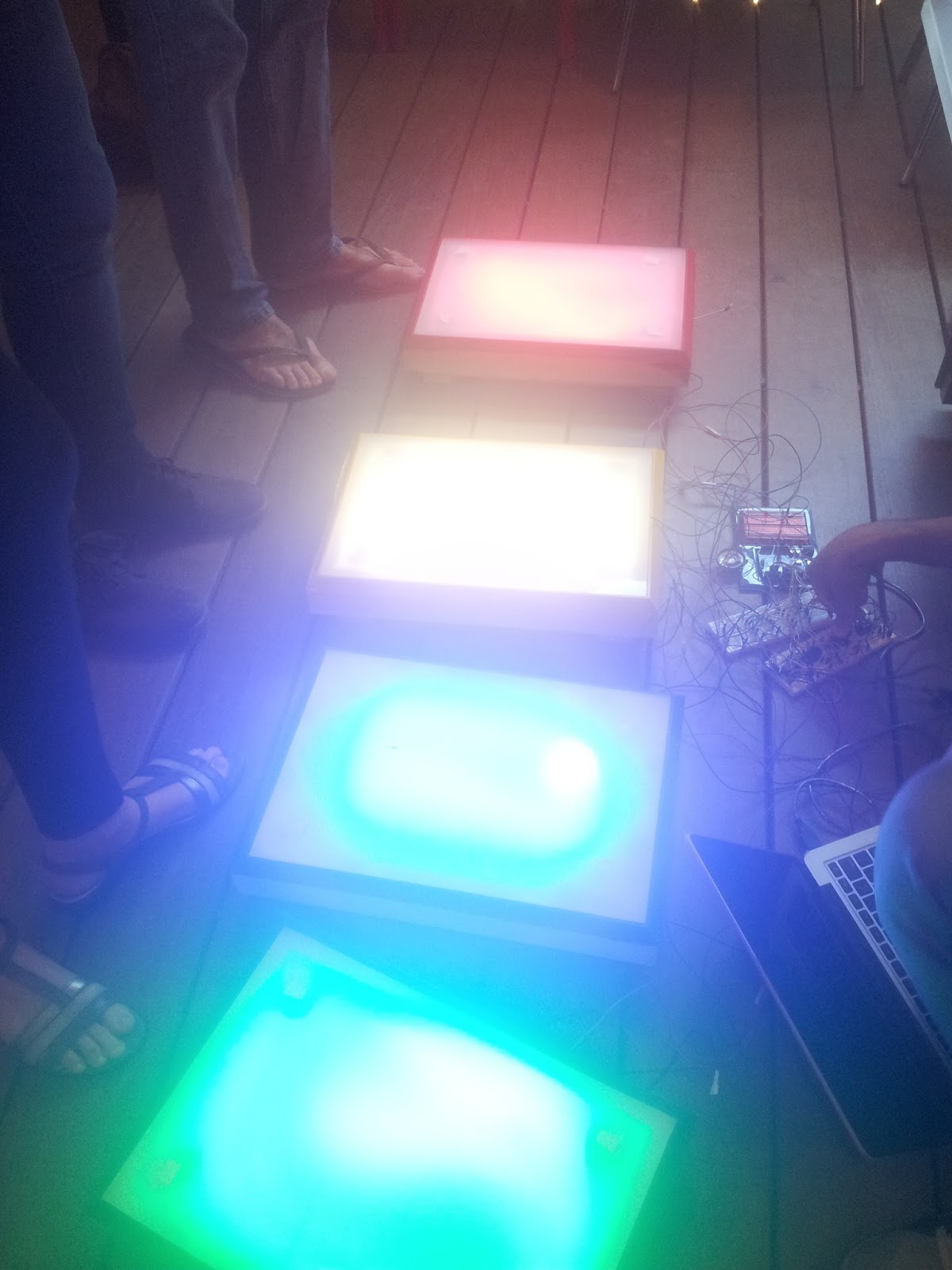
Yesterday we brought to class 4(!) buttons and let our classmates play with them (video soon). They seem to be fun, when they work properly, we still have touch ups to do (mainly with the electronics, we might change the angle of the buttons) to improve the experience.

Ta-da! Four buttons and a bunch of wires:


Doron and Dudi fix things up in between games, you can see the current wiring and try to spot our aluminum foil coated erasers :)-


 And....Our 7 segment display! So pretty. Will  be place between button #2 and #3 so that the players could know their and the other side's score without looking elsewhere-


Saturday, April 27, 2013

Animatic the 3rd


We wanted to update the animatic after we got a few comments, Doron took some pencils and started sketching.

We liked the previous one as well so we wanted to give it a try with the new musical choice-


Friday, April 26, 2013

Fellow Simon Games- Super Simon

A cute video Doron found:

So, we didn't invent a Simon-match. Seems really fun!

Saturday, April 20, 2013

New User Flow

We're still not sure about the correct flow. In the next few weeks we will perform a few more user tests for these delicate touch-ups. This is the user flow for now (click for larger view):


Sunday, April 14, 2013

New Storyboard and Animatic


Based on comments by the miLab staff and studetns, paper prototype users and friends.

A few comments we got after showing it in class-

  • US/THEM, may seem not enough friendly an fun but as acontest
  • Change song to acoustic version
We will shoot a new and updatd concept video in a few weeks (with the new and operating buttons!), it'll be quite similar to the first one, and this animatic, but with better interaction. 

Do you have any comment about the animatic?

Tuesday, April 9, 2013

Storyboard #2

Our team's communication division (Tamar and Alex) was seated in an isolated room with a few blank pages and a pen. Mission Storyboard was about to begin. Doron is the one that is good with pencils, we could barely draw two black lines without releasing a deep sigh.

Results:


Monday, April 8, 2013

The Tale of the 50 Erases (or: A New Design)

Another version to our button:

As seen below, we changed the way the circuit is closed. For now we used erasers (Dudi and Yael bought 50 erasers, the cashier was shocked) but in the next version we'll use rubber. The middle of the button remains empty to allow a nice spread of the LED light.
To be continued!

Sunday, April 7, 2013

A small thank you to Safam Boards!

We would like to thank "SAFAM BOARDS" for letting us use their studio and facilities to build our StreetSimon prototype and for inspiring us along the way! SafamBoards is a young company that makes high quality boards. 


These guys love riding boards, so they put a lot of thought and dedication into the making of their each one of their boards, enjoy the productions process, and always try to improve. Originally from Tel Aviv City, Lavi and Barak are urban beings and so are their boards. Moreover, some of their designs are suitable for the great outdoors. The boards are built from different combinations of beech wood layers, pressed into their concave, heated with micro wave technology. The boards are assembled with top grade trucks, wheels and bearings, and are decorated with custom made graphics. 


https://www.facebook.com/SafamBoards 
Location: 12 Hazak st. Tel Aviv-Yafo, Israel 
Longboards manufactures; +972-546200913 Lavi, +972-525674313 Barak

Saturday, March 23, 2013

Specification Doc

After some more research and brainstorms we came up with a specification document for our Simon, courtesy of Tamar.


1. General
1.1         Objective
1.1.1          The Street Simon Prototype will enable a short and fun interaction with the game for a single user.
1.1.2          The Street Simon Prototype will enable a short and fun interaction with the game for multiple users, both on the same side of the sidewalk, and on opposing sides of the sidewalk (henceforth known as Side A and Side B).
1.1.3          The Street Simon Prototype aims to pass the time for pedestrians waiting for the traffic light to change, and so the game will only be active while the pedestrian traffic light is red.

1.2         General Physical Requirements
1.2.1          8 life sized switches (4 for each interface)- 2 red, 2 yellow, 2 green and 2 blue
1.2.2          An analogue screen for the score board

1.3         Additional Notes
1.3.1           The game patterns will be composed of 4 visual and audio elements- element A (blue light, sound 1), element B (Red light, sound 2), element C (Green light, sound 3), element D (yellow light, sound 4).
1.3.2          “Single Player” mode refers to a game where only one of the sides is playing (either side A or side B). On one of the sides, there could be a number of players playing together, however the game will not differentiate between many players on one side and one player on that same side.
1.3.3          “Multiple Players” mode refers to a game where both Sides A and Sides B are playing simultaneously.

1.4         Synchronization with Pedestrian Traffic Lights
1.4.1          The timing program of the relevant pedestrian traffic light (for which the game will be placed) will be measured before placement of the game. 
1.4.2          The game will be active at all times when the pedestrian traffic light is red.
1.4.3          The game will be inactive when the pedestrian traffic light is green.


2. Beginning the Game
2.1         Objective
2.1.1          The User will be able to instinctively understand how the game works.
2.1.2          The system will be able to identify the type of game (single player or multiplayer).

2.2         Commencing the Game
2.2.1          The initial game sequence will commence once the user steps on the “Pad” which presents a drawing of footprints and is accompanied by the text “Stand here to begin Playing”.
2.2.2          The initial game sequence will include a short sequence of all the 4 elements in a pattern, and will indicate the beginning of the game to the user.
2.2.3          If the system identifies a player on both Side A and Side B, the game will act as a multiplayer game.
2.2.4          If the system identifies a player only on one side of the game (either Side A or Side B), that game will act as a single player game.


3. Single Player Mode
3.1         Objective
3.1.1          The user/users on a single side will be required to repeat patterns.

3.2         Interaction
3.2.1          The user/users on a single side will be required to repeat patterns.
3.2.2          Each pattern completed is equal to one level.
3.2.3          The patterns increase by the addition of a single element as each level increases.
3.2.4          Each time the user completes a pattern, the completion sounds will be played.
3.2.5          If the user steps on the wrong key (for example the pattern provided was red-blue-green and he pressed red-green), this means he has failed the game, and the “game failed” sound will be played

3.3         Restarting the Game
3.3.1          If no keys are pressed during the game for 15 seconds, the game will restart.
3.3.2          If the user has failed the game, the game will restart.
3.3.3          If the pedestrian traffic light turns green, the game will restart but be inactive until the traffic light is red once again.

3.4         Score
3.4.1          A counter screen displaying the word “score” and increasing digits will be created.
3.4.2          Each completion of a pattern rewards the player with one point.
3.4.3          The scoreboard will reset to 0 every time the game “restarts”.


4. Multiple Player Mode
4.1         Objective
3.4.1          The user/users on a both sides of the crosswalk will be required to repeat patterns and compete against each other.

4.2         Interaction
4.2.1          Both interfaces on side A and side B will carry on autonomously and accordingly to the requirements made in section 3.2 and 3.3.  

4.3         Score
4.3.1          The only addition made in multiplayer mode refers to the scoreboard.
4.3.2          Once the system identifies a multiplayer game, the scoreboard will consist of “Your Side” and the increasing score (referring to the score of that specific Simon interface), and “The Other Side”, which will show the increasing score of the player on the other side of the crosswalk.
4.3.3          Once the game ends, either by one of the players ceasing to play, or by the traffic light changing to green, the scoreboard on the side with most points in that session will present the text “You Win!”. The score board on the losing side will present the text “The Other Side Wins”.
4.3.4          If one of the sides “fails the game”, the other side will be declared winner and the failing side will be presented with the text “The Other Side Wins”.

Thursday, March 21, 2013

Presentation at Class with 1st Prototype

Last week at class we all gave a short presentation of our prototypes at their current state- our one Simon button did not change (besides the color :) ) but we have some new resolutions regarding it's next design. After Passover we intend to have four working buttons with a more suitable design- mainly smaller and closer so that one person can interact with it alone with no difficulty.


Saturday, March 16, 2013

Paper Prototype User Study

On Wednesday  Tamar and Doron went to Tel Aviv University and gave students and other pedestrians a chance to play Red Light Simon.


Conclusions:
1. Smaller Buttons- closer to each other and smaller by size (easier fot one to play alone, still comfortable for two or three players)
2. Multiplayer or solo by choise- the first player can invite bystanders but the game is not multiplayer by default
3. Players like being competative and playing againg the other side is a big plus
4. Must have a scoreboard
5. Different types of playing- some bounced from button to button and others touched the edges gently (might be due to the size, shape and overall physical space used)
6. For bystanders that don't play it's a great preformance

Wednesday, March 13, 2013

Making of the 1st Simon Button


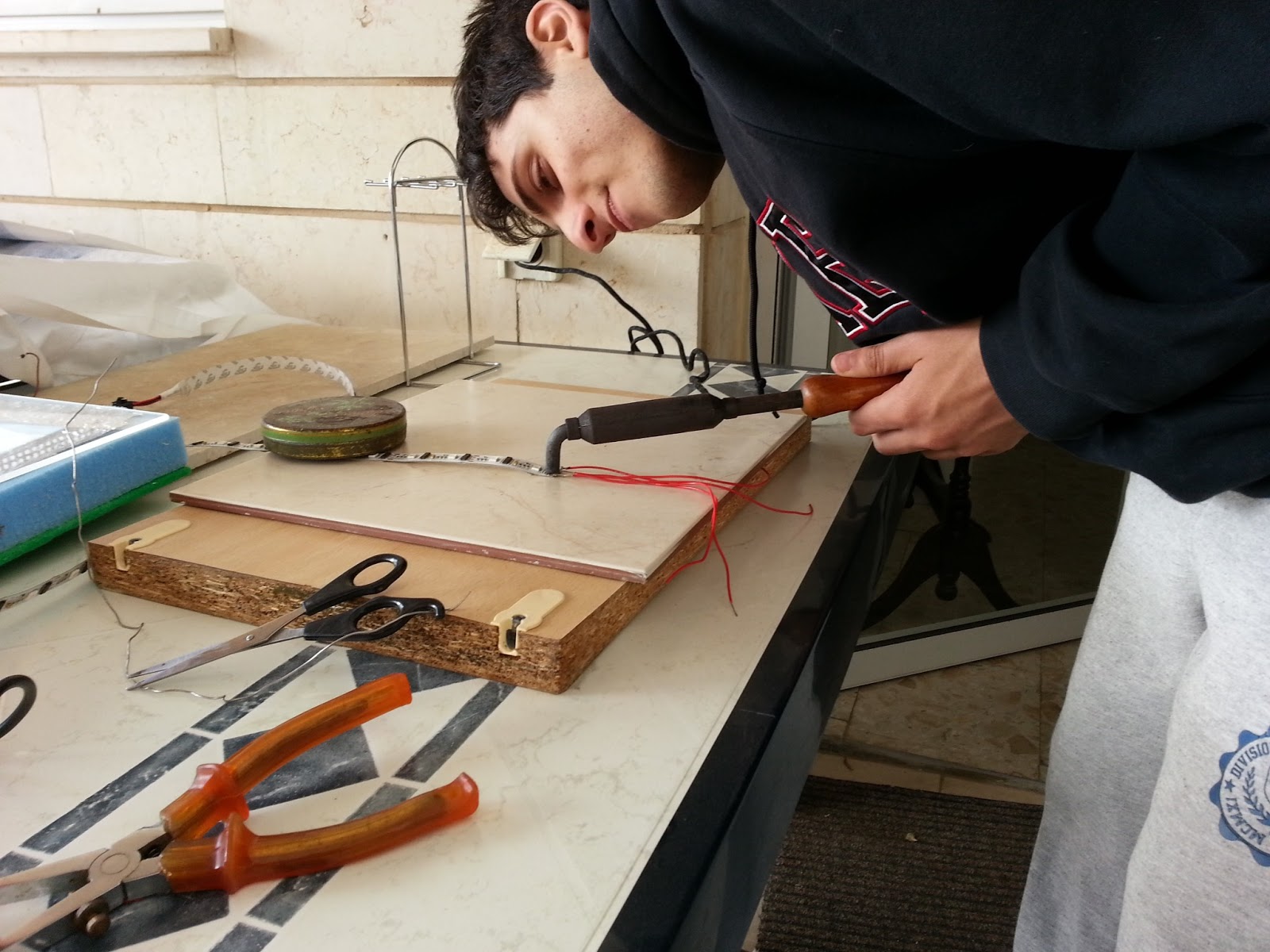
 Dudi and Yael used an acrylic glass cover for a sponge frame. They used aluminum foil to close an electrical circruit. The LED's are super bright LED- green for now.


Wednesday, March 6, 2013

Prototyping

This week's main goal is to create a few versions of the Simon "buttons". Dudi and Doron had a workshop today and these are their creations:


This button is made of sponge, wood and acrylic glass. The sensor in this version is a weight sensitive one to ensure durability. Over the next few days we will try a few more designs, ideally.

Sunday, March 3, 2013

Select and Refine

Still need to determine what is the core of our Simon- it's been hard to choose which goal is the main one. We wanted to combine playing a game and connecting with others (fun), passing the time (lower anxiety) and producing electricity (ecological).

As advised by mentors and the miLab staff, we must have one thing that defines the interaction and will attract pedestrians to play.

Two tests can determine if Simon works-
  1. people prefer "Simon"ed crosswalks over plain ones.
  2. people keep on playing after the light turns green.
For now Simon will consist of two "consoles", one for each side of the crosswalk that can be played by 1 to 4 players. The pattern is the same for both sides and the score is gained by the number of patterns achieved in a certain amount of time (red light length). The connection can be made by the players in the same side and between the sides.

For now we will focus on the fun aspect of Simon- passing the time and connecting to others via the game.

For next week we need to prepare a few options of buttons (based on the Arduino prototype when the materials and mechanisms are varying and possible pressure to be applied is to be tested),start working on a new storyboard and plan a user study flow. We have a few industrial design students for friends, time to "take" a hand from them.

Wednesday, February 27, 2013

The Hardest Button

We have been thinking and consulting others regarding the Simon buttons prototype. Here are a few pointers we consider, when the basis is two surfaces and something to control the stepping/pressing process:
  • Two surfaces with aluminium foil that will transmit a signal when pressed
  • A spring or a few springs between the surfaces when the sensor is in the center and is sensitive to pressure- may be hard to stable
  • Placing sponge of some sort between the two surfaces- not "clickable" and may confuse when pressing
  • Pedal/stepper kind of button- using a door hinge at the far end and the sensor at the close end
The top surface will probably be made of fiberglass to ensure durability after long usage. The Arduino sensor will be a button or a pressure sensitive strip.

Monday, February 25, 2013

Goals and Deadlines


Yael and Doron met with Guy and Noa and discussed the goals and deadlines for this semester until the final presentation in mid-May.

Issue 1: Electricity- 
Deadline: 3.3 (Decision and proposals to Noa/Guy) 
Dudi and Yael

a) Finding an electricity specialist
b) Defining and Purchasing Hardware
c) Powering the fans?

Issue 2: the game interaction- Deadline- 17.3
Tamar, Alex and Doron
3 Options of Interactions:
  • Single player- only build one prototype, one side plays by himself (however multiple players can be on the same side
  • Multiple player as originally planned- two prototypes, functioning autonomically and separately as a contest develops between both sides of who manages to complete more patterns
  • Active and passive side of players (guy's suggestion): one side gets a tablet from which he can provide patterns for the other side. The other side has a simon interface as planned, but needs to repeat the patterns provided by the side with the tablet.
  • Divide the 4 colored buttons between both sides of the street. Both sides receive the same patterns, but each side is responsible only for the buttons on his side (e.g. one side of the street has the red and blue buttons and the other side green and yellow). On each side of the street we have speakers, so that they hear the full pattern and hear the pattern completions by the other side. The disadvantage of this that it will only work with multiple players.
Pointers after we choose the interaction:
  • What are the rules of the game? How do we begin- how do we deal with users unfamiliar with simon? how do we convey the rules/points/harversting meter?

  • An explanation of the rules is required if we choose interaction c and maybe b.
  • How do we address a single player scenario
  • How do we address multiple player on same side scenario
  • How do we address multiple player on both sides scenario
  • Do we create a gaming "world" for street simon (e.g. contests of who gets most points, who harvests most energies) 

  • Suggestion: consult with gamification expert to discuss game rules. 

    Issue 3: Building the prototype- Deadline: 7.4 
    Dudi and Yael
    • One or two prototypes??? 

  • How do we physically build the prototype
  • The physical, life-size, plastic/fiberglass surface? 
  • Buttons, sound and colored lights
  • Information screens (for electricity, points, timer)

  • Dudi and Yael need to meet with Guy about this, Guy suggests: 
    Perspex plate, with a sticker so it won't be transparent. Underneath colored LEDs. Or the plastic will be colored and the LEDs will be white. 
    The Perspex will be on a hinge with a spring, that will be connected to the button of the Simon, so when you press down it will activate the button.
    Issue 4: The movie- Deadline: 28.4
    Tamar, Alex, Doron
    • storyboard that properly conveys interaction 17.3

  • storyboard animatic 7.4


  • Issue 5: The User Study
    Tamar, Alex, Doron
    • study 1- paper prototype- how do we do this? - 17.3

  • study 2- working prototype- 28.4 


  • Issue 6: Presentation (Mid May)
    Booth- one or two Simons

    Issue 7: Traffic lights timing 
    Do we address this? Meet with the Tel Aviv municipality? Or for the prototype since we can have this timed should we not deal with it?

    This evening we have a hangout with Noa to address a few of these issues.

    Tic toc.

    Thursday, January 17, 2013

    Presentation Day

    We did it!

    It wasn't easy and many many drafts found their way to the recycle bin- physical and metaphorical.

    Voila!


    On the more general and positive side of the feedback given by those present, we were told that our project is exciting, that we were focused and in the right direction. One of the mentors even stated that he’s “dying to play it”. On the other hand, a concern was raised that due to the nature of the interaction the user’s inclination to participate in it might be simply dependent on his/her particular mood.

    A few pointers we got:
    • It was brought to our attention that the flow of the interaction was not clear enough. One question was raised regarding how exactly the game is played, and if the user is simply expected to react to the system each time. We were also told to clarify how the flow of the game will match the timing of the traffic signal.
    • One question was raised regarding the synchronization of the game with the traffic signals: Are we in fact going to sync with municipality data and programs, or should we perhaps attempt to track the timing ourselves with the use of a photo-resistor?
    • The traffic signal count-down-timer feature was in general well received, although some comments suggested that we should rethink how and where to make this indication (one suggestion was on the pavement, since that’s where the user will focus his/hers attention while playing the game)
    • It was also stated that more thought should be given as to how to best present all the data we wish (points, timing, electricity produced) on the traffic light/ game surface.
    • Suggestions were made as to where exactly Street Simon should be placed. One opinion was placing the interaction near schools, children would perhaps be more oriented and inclined to participate in such interactions. This associatively reminded the commenter of the piano scene in the movie “Big”. Another suggestion was to even implement the game in building while waiting for elevators.
    • More debate regarding the game placement- in crowded or less crowded areas? Concerns were raised regarding potential over-crowding and accumulating lines to play the game (especially during rush hour), or even people fighting over who gets to play. 
    • Some proposed that too few pedestrians would more likely become an even larger issue, as playing the game alone, although possible, might not be as interesting and will not meet the goals of the interaction. 
    • We were advised to research busiest street times and areas and try to make some observations ourselves.
    • One comment stated that our study does not truly represent the user scenario as our presence influence the interaction. We were thus advised to conduct more passive observational research, in which pedestrians simply run into the unfamiliar game and we observe their interaction with it. 
    • Another opinion was that in fact the study conducted was efficient for the current stage of the project as a more basic exploratory phase.
    • The prototype demo: some thought it was a nice touch, some thought it was pointless.
    • As for the main objectives and focus of our product, some said they were fond of the social factor of the game and also of the electricity generation potential. Another opinion was that we should be more focused on one objective: Either passing the time in an enjoyable manner, connecting with others through crowd interaction, or producing electricity.
    All in all the feedback was pretty positive, we took notes and have sort of an idea how to continue from here.

    So long fall semester, hello exams period!


    Wednesday, January 16, 2013

    New Concept Video for Red Light Simon!

    Team tydda is proud to present Red Light Simon's new concept movie!


      The song is by the local The Wake Up Suzzys and it is called A Lady's Man. Thanks guys :)

    Our post-production efforts didn't go well so the green rectangles remained green. But the sound really helps understand the interaction, don't you think?

    Tomorrow is this semester's big day and we were instructed to get a good night's sleep so- g'night!

    Monday, January 14, 2013

    New Concept Visualization

    Our very own Doron and his adorable nephew Uri:


    The pedals are aligned in a way that a number of people can play and will light up when pressed or when presenting another step for the player. The traffic light poll will include information regarding the time remaining, the current score and the watts gained.

    Getting ready to shoot the new concept movie, a new and improved storyboard was made by Doron:


    Rehearsing our concept presentation to the miLab mentors and staff this Thursday. Excited.

    In the meanwhile, here's a nice Israeli red light related project we found the other day- 
    enjoy!

    Saturday, January 12, 2013

    Shooting New Red Light Simon Concept Movie


    Schedule for Red Light Simon Concept Movie:

    08:30AM EARLY CALL :) Coffe+Pastery@TheBakery!
    09AM-Location preparation – art props installment!
    0930AN-Recording street audio
    10AM First shot – Doron and Uri action into simon
    1015AM Legs Doron and Uri(6y/o) playing simon close up
    1030AM CLOSEUPS! HIGh5 Action
    1045AM Long shot Doron and Uri
    1100AM – Dana coming to red light -
    1115AM Closeup Dana playing Street Simon
    1130 AM Long shots Dana playing
    1145 Uri Closeup
    1200PM –Long shot Crossing Green light! Dramatic moment eyes crossing.
    1215PM Green light crossing, another angle.
    1230PM it's a wrap- splitting to editing and user study

    Friday, January 11, 2013

    IT'S ALIVE!

    Yael and Dudi are evil geniuses that have created an Arduino based fully functioning Simon!


    Pretty cool!

    Tuesday, January 8, 2013

    Tech Overview

    Our system will consist of 2 individual “Simon’s” connected via Wi-Fi used to keep score and time between both players simultaneously.

    Each Simon will be based on a piezoelectric surface, a unique surface that creates electricity when applying pressure to it. On this surface we will place colorful buttons that are meant to be pressed and will apply pressure on the piezoelectric surface along with an audio-visual feedback for the player.

    The game itself will be managed using an Arduino chip that will be connected to the buttons and to speakers in order to produce sounds.

    Main technological challenges:

    1. Creating a significant amount of electricity and storing it
    2. Connecting to the traffic light data center in order to time each game according to the length of the red light in each intersection (each traffic light has p to 12 different programs every day)